Trusted by12,000+Australian sellers · Updated for 2026
Agent Fees & CommissionGuide
Understand how agent commissions work, compare fee structures and estimate your selling costs — with real, suburb-level data from across Australia.
100% Free
No Obligation
Compare Top Agents
Live Local Data
Aligned incentives
Agents only get paid when your property sells — so they’re motivated to get you the best price possible.
― The Why
Why do real estate agents chargecommission?
When you pay an agent commission, you’re paying for the three things that truly drive a successful sale: finding qualified buyers, negotiating the best possible price, and managing the entire process through to settlement.
You’re not paying for signboards or photography. You’re paying an agent to find the right buyer, negotiate hard on price, and shepherd the deal from listing through to settlement.
— The Agent Choice Insights Team
Finding & securing the right buyer
Agents leverage their buyer database, network, market knowledge, inspections, and sales expertise to attract qualified buyers — and create the competition that drives a strong result.
Negotiating the best possible price
Experienced agents know how to manage buyer interest, create competitive tension, and negotiate favourable terms — turning offers into the best possible outcome for the seller.
Managing the entire sales process
From listing to settlement — coordinating enquiries, inspections, contracts, and communication with solicitors and conveyancers — agents keep the transaction moving smoothly.
─ The Rules ─
Are commissionsregulated in Australia?
There’s no single national commission rate. Each state and territory sets its own framework — but every agent is legally required to disclose their fees, and you’re entitled to negotiate.
01
State-based rules
Commissions aren’t federally regulated. Each state and territory provides its own guidelines on what agents can charge and how it must be disclosed.
02
Full disclosure required
Agents are legally required to disclose their commission rates and fees up-front before you sign any agency agreement.
01
State-based rules
Commission isn’t fixed — sellers can negotiate. Comparing multiple agents typically reduces your final rate by 0.3–0.7%.
─ Three Models ─
The most commoncommission structures
Australian agents use one of three pricing models. Knowing the difference could save you thousands at settlement.
Most common
Percentage Based
1.5% – 3.0% of sale price
The traditional model — agents charge a percentage of the final sale price as commission. Incentivises agents to achieve the highest possible price.
Typical Range
2.2%
Performance-based
Tiered Commission
Varies with sale price
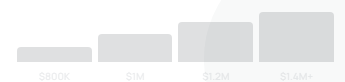
Commission percentage scales up or down based on the sale price — rewarding agents for exceeding price targets and aligning incentives with your goal.
Performance Bands
Rising trend
Flat Fee Commission
Fixed amount, regardless of sale
A single, predetermined fee for the agent’s services. Offers complete cost certainty — especially attractive for higher-value properties.
Example Flat Fee
FIXED FEE
$12,500
― Deep Dive
What is aflat feecommission?
Flat fee commissions are gaining popularity across Australia — particularly for higher-value properties. Instead of paying a percentage of the sale price, you pay a single, fixed amount for the agent’s service.
Why this matters
On a $1.5M sale, a 2.2% percentage commission costs $33,000. A flat fee of $12,500 could save you over $20,000.
The trade-off is transparency vs. alignment: a flat fee gives you cost certainty, but a percentage rate keeps the agent financially motivated to push for a higher final price. The right model depends on your property, your market, and the agent you choose.
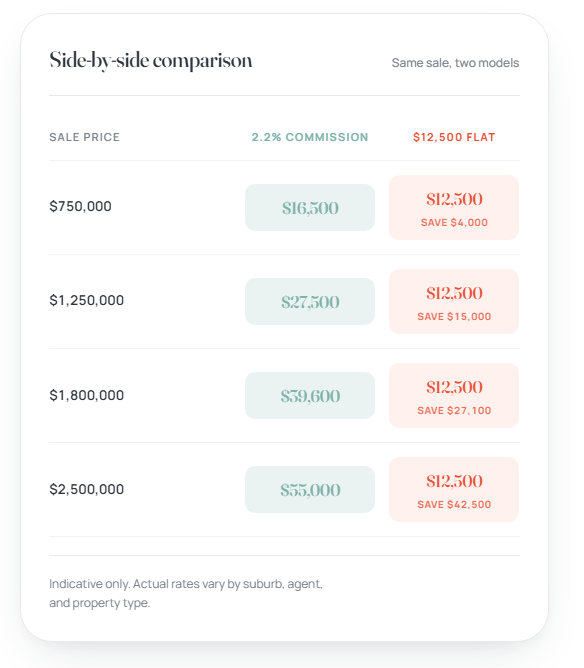
Side-by-side comparison
Same sale, two models
Sale Price
2.2% Commission
$12,500 Flat
$750,000
$16,500
$12,500
SAVE $4,000
$1,250,000
$27,500
$12,500
SAVE $15,000
$1,800,000
$39,600
$12,500
SAVE $27,100
$2,500,000
$55,000
$12,500
SAVE $42,500
Indicative only. Actual rates vary by suburb, agent, and property type.
─ By the numbers ─
Average commission ratesacross Australia
Commission norms vary considerably by state — driven by local competition, median price points and market maturity. Here's how the typical agent rate stacks up nationally.
NSW
New South Wales
Sydney & surrounds
1.95 %
Tight inner-city competition pulls rates lower
VIC
Victoria
Melbourne & regional
1.85 %
Australia's most competitive agent market
QLD
Queensland
Brisbane & coast
2.55 %
Higher rates reflect wider geographic spread
WA
Western Australia
Perth & surrounds
2.40 %
Recovering market, more room to negotiate
SA
South Australia
Adelaide & regions
2.25 %
Steady mid-tier rates statewide
TAS
Tasmania
Hobart & statewide
2.75 %
Smaller agent pool, higher service rates
ACT
Australian Capital Territory
Canberra
2.25 %
Compact, professional market
NT
Northern Territory
Darwin & regions
2.95 %
Remote markets command premium rates
Indicative averages compiled from Agent Choice's network data. Your actual rate will depend on the specific suburb, property type and agent — use the calculator above to see suburb-level figures.
─ A five-step framework ─
How tocompare agent proposals
When you're weighing up two or three agents, the cheapest commission isn't always the right call. Run every proposal through these five checks.
1
Compare on net proceeds, not commission
A higher-commission agent who consistently sells above appraisal can net you more than a discount agent who underdelivers on price. Always run the maths on the final figure in your pocket.
2
Scrutinise the marketing plan
Look at how the marketing budget is being deployed — premium portal listings, professional photography, video, social, signboards. A skimpy campaign on a quiet listing rarely produces competition between buyers.
3
Check recent comparable sales
Ask each agent for three to five sales they've closed in the last 6 months in your suburb, with comparable property type. Sale-to-list ratios above 100% and short days-on-market are the markers of a sharp negotiator.
4
Read the agency agreement carefully
Watch for sole-agency length, exclusion clauses, marketing commitments, and what happens if the property doesn't sell. A 90-day exclusive can become a problem if the relationship breaks down early.
5
Trust your read on the agent themselves
Selling is a months-long relationship under pressure. Pick the person who communicates clearly, is candid about price expectations, and treats your home like a real asset — not a number on a board.
6
Get a second opinion from data
Performance data — sale ratios, average days on market, suburb specialisation — is the antidote to a smooth pitch. Use it to validate (or challenge) the story each agent is telling you.
─ Watch outs ─
Common mistakessellers make
A handful of avoidable missteps account for the majority of disappointing sale outcomes. Knowing them in advance is half the battle.
Mistake 01
Picking the agent who quotes the highest price
"Buying" the listing with an inflated appraisal is a known tactic. If you list above market, you sit unsold, the property goes stale, and you eventually drop the price under pressure — often below where a realistic listing would have landed.
Avoid by:Asking each agent to back their price with recent comparable sales, not market hype.
Mistake 02
Skimping on marketing to save a few thousand
Underspending on marketing is the most common false economy in real estate. A property that doesn't get seen doesn't get bid on — and the missed price is invariably many multiples of the marketing saving.
Avoid by:Budgeting marketing as a percentage of expected sale price, not as the smallest number you can negotiate.
Mistake 03
Signing without reading the agreement
Sole-agency terms, exit clauses, marketing schedules, what happens after withdrawal — these are all negotiable, but only before you sign. Once you've committed, your leverage is gone.
Avoid by:Reading the contract end to end and asking for changes to any clause that worries you.
Mistake 04
Underestimating the cost of a slow sale
Mortgage repayments, council rates, insurance, utilities — they all keep running while your property sits on the market. A slightly-too-high asking price that adds three months to the campaign can cost more than the next price reduction.
Avoid by:Pricing for a realistic 30–45 day campaign, then adjusting fast if the market signals a different number.
─ By the numbers
Why thecheapest agent is rarely the best choice
It's tempting to pick the proposal with the lowest commission. Half a percent feels like real money — on a $1m sale, that's $5,000 you could keep. But this calculation almost always misses the point.
The agent's job isn't to charge you less. It's to negotiate a better price than you would have achieved without them. The gap between a sharp negotiator and an average one is rarely fifty basis points — it's usually closer to 2–5% of the final sale price.
Sale-to-list ratio.Top performers consistently close above appraisal. Below-average agents drift below — and the gap dwarfs the commission difference.
Buyer competition.A well-run campaign produces multiple bidders, and competition is what produces premium prices — not a discount agent's listing.
Days on market.A skilled agent closes faster, reducing your holding costs — which often outweigh any commission savings.
Negotiation skill.The hardest dollars to extract are the last few percent at the top of the offer range — and that's where top agents earn their fee many times over.
We always tell sellers: the question isn't who charges the lowest commission. It's who will put the most money in your bank account on settlement day, after every cost is paid.
─ Agent Choice — Seller Advisory Team
2–5%
Typical sale-price gap between top and average agents
0.5%
Typical commission saving from picking the cheapest option
Find out if you’repaying too muchin commission.
Compare verified commission rates from top-performing local agents in your area — identified by Agent Choice based on real performance data — so you can sell with confidence and avoid overpaying.
Compare Top Local Agents
See verified data on the highest-performing agents in your suburb — ranked by sale price, days on market, and commission rates.
Calculate Your Cashback
When you sell with one of the top-performing agents recommended through Agent Choice, you may be eligible for a cashback bonus at settlement. Find out how much you could earn.
Free Property Report
Get a comprehensive property report with recent sales, market trends, and a suburb-by-suburb commission breakdown.
─ Property Tools & Insights ─
Explore ourproperty tools
From agent commissions to capital growth — every tool you need to make informed property decisions in one place.
Agent Fees & Commission Guide
Understand how agent commissions work and estimate the average rate in your suburb.
Agent Fees & Commission Guide
Understand how agent commissions work and estimate the average rate in your suburb.
Find your agent
Agent Fees & Commission Guide
Understand how agent commissions work and estimate the average rate in your suburb.
Agent Fees & Commission Guide
Understand how agent commissions work and estimate the average rate in your suburb.
Indicative averages compiled from Agent Choice's network data. Your actual rate will depend on the specific suburb, property type and agent — use the calculator above to see suburb-level figures.
─ Property Insights ─
Related property insights
Fresh perspective and practical advice from the Agent Choice Property Insights team.
March 20th, 2026
When Is the Best Time to Sell Your House in Australia
Compare top-performing local agents, review their track records, and choose with confidence. Agent Choice helps homeowners make informed decisions by identifying high-performing agents based on real performance data.